

What this means for you?
If this proposal passes the legislative procedure, tectonic changes await public procurement. The new rules would apply to both public and utilities (sectoral) contracting entities as well as to concessions. This is an approach that in practice means starting over: the theoretical concept of procurement remains the same, but the details and novelties are extremely numerous.
In our assessment, this is the biggest change to the public procurement system in the last 30 years. We emphasise at the very outset: for now this is only a draft Regulation (the Commission’s proposal), not an adopted act. Through the ordinary legislative procedure, in which the European Parliament and the Council take part, the content may still change significantly before final adoption. The deadlines and individual solutions described below are therefore indicative.
Why new rules at all?
The current framework consists of three 2014 directives: Directive 2014/24 on public procurement, Directive 2014/25 on procurement in the water, energy, transport and postal services sectors, and Directive 2014/23 on concessions. Each Member State transposed these directives into its own legislation (in Croatia through the Public Procurement Act), which led to fragmentation, legal uncertainty and the risk of so-called “gold-plating” — adding stricter national rules on top of what the EU requires.
The Commission’s evaluation, as well as the reports by Mario Draghi and Enrico Letta on competitiveness and the single market and, in particular, the special report by the European Court of Auditors, revealed the same weaknesses: procedures are complex and inflexible, award on the basis of the lowest price alone still prevails, competition for contracts is declining, and participation by small and medium-sized enterprises and cross-border bidders remains limited. In addition, the rules on market access for non-EU companies are unclear and no longer match today’s geopolitical reality. Public procurement accounts for around 15% of the EU’s GDP, so the Commission decided to set the framework up anew.
Key novelties of the draft Regulation
1. A single instrument instead of three directives
Instead of three separate directives transposed into national law, we get a single directly applicable Regulation covering both public contracts and concessions, and both classic and utilities contracting entities. Direct applicability means the rules apply uniformly across the Union, without separate transposition and without room for national deviations. The legal basis of the proposal is Article 114 TFEU (the internal market).
It is worth highlighting one practical consequence: like the current directives, the Regulation will apply to high-value procurement (above the European thresholds). This means the national Public Procurement Act will no longer cover high-value procurement, but each Member State will have to adopt its own rules for below-threshold procurement.
2. New types of procurement procedures
The standard procedure becomes the open-negotiated procedure, which combines the transparency of the open procedure with the possibility of negotiation. Two new procedures are introduced alongside it:
- the dynamic simplified procedure: for the recurrent procurement of standard, “off-the-shelf” solutions from the market;
- the innovation challenge procedure: for the development and procurement of innovative solutions not yet available on the market, where the contracting authority defines a societal challenge instead of fixed technical specifications.
At the same time, selection criteria are limited to what is necessary and proportionate. Excessive turnover requirements and unjustified demands for prior public-sector experience are curtailed.
3. The mandatory “Needs Plan”
Public contracting authorities will be required to publish a Needs Plan at the start of each budgetary period. The aim is greater predictability and earlier integration of strategic considerations into the procurement cycle. In addition, market consultations in the preparatory phase are explicitly encouraged, with safeguards against distortion of competition.
4. Best price-quality ratio as the rule
Contracts will as a rule be awarded on the basis of the best price-quality ratio rather than the lowest price alone. Minimum quality weightings are introduced, higher for labour-intensive contracts. Where a contracting authority wishes to deviate from this criterion, a “comply or explain” logic applies — deviation is possible but must be justified.
5. Strategic procurement: green, social, innovation
The proposal more clearly regulates the legal bases for strategic procurement objectives. On the environmental side, it strengthens procurement’s contribution to the circular economy, recycled and refurbished content, waste recovery and energy efficiency, with mandatory green requirements for certain product categories. On the social side, it develops objectives such as social inclusion, labour-market integration, accessibility and better working conditions, while retaining reserved contracts and special rules for social, health and education services. On the innovation side, the new innovation challenge procedure enables the procurement of solutions developed “tailored” to a societal challenge.
6. Security and strategic autonomy
A new chapter on security and resilience is introduced. Contracting authorities will be able — and in certain cases required — to take into account risks related to critical infrastructure, cybersecurity, supply-chain resilience and undue third-country influence. The possibility of a European preference is introduced: restricting participation, requiring a minimum share of EU or covered-country origin, and granting preference in evaluation. The Commission also gains an online tool to check whether a particular economic operator or product is “covered” by the Union’s international commitments.
7. Digitalisation: a single digital ecosystem
The proposal establishes a single digital ecosystem for public procurement based on interoperability and common standards. A key novelty is the electronic eligibility service built on digital business credentials, which implements the “once-only” principle — data an operator has submitted once need not be submitted again. National public procurement data spaces are also established, linked into an EU-level data space.
8. Consolidated exclusion grounds
Exclusion grounds are currently scattered across more than ten sectoral acts. The proposal consolidates them into a single framework: 7 mandatory exclusion grounds (serious criminal offences — corruption, human trafficking, terrorism, etc.) are centralised within the Regulation, together with a new mandatory ground related to deforestation (under the Deforestation Regulation). Grounds from the rules on waste, ecodesign and pay transparency are absorbed into the existing optional exclusion ground.
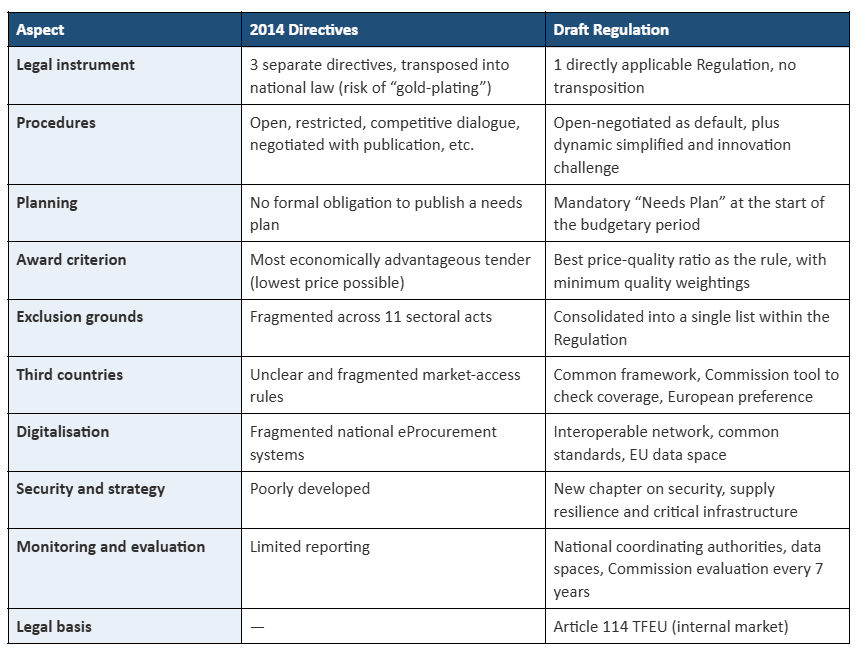
Key differences compared with the 2014 directives
What should contracting authorities and bidders do now?
Although this is still only a proposal, it pays to start preparing in good time:
- Follow the legislative procedure and the consultation. Taking part in the public consultation is an opportunity to influence the text while it is still open to amendment.
- Familiarise yourself with the new procedures. The open-negotiated procedure, the dynamic simplified procedure and the innovation challenge bring a different logic to preparing documentation and evaluating tenders.
- Contracting authorities: consider the “Needs Plan”. Early preparation of the plan and of market consultations will ease the transition once the obligation takes effect.
- Check your readiness for the quality criterion. The shift from the lowest price to the best price-quality ratio requires developing qualitative criteria and weightings, along with justifications under the “comply or explain” logic.
- Bidders: prepare for the European preference and the security requirements as well as for digital business credentials under the “once-only” principle.
- Watch the rules for below-threshold procurement. Since the Regulation covers only high-value procurement, it will be crucial how Croatia regulates below-threshold procurement.
At PJR Civitta, we are closely monitoring the development of this proposal and its potential impact on contracting authorities, economic operators and EU-fund beneficiaries, and we will report in a timely manner on every important stage of the legislative procedure.
Source and full text: Proposal for a Regulation on public procurement — European Commission announcement (EURACTIV): https://www.euractiv.com/news/commission-to-unify-eu-procurement-rulebooks/.
This article is informative in nature and does not constitute legal advice. As it concerns a draft proposal for a Regulation, the final text may differ from what is described here.